
In a world where innovation and technology are constantly shaping the way we perceive reality, holographic stickers emerge as a captivating intersection between artistry, science, and consumer culture. These iridescent, three-dimensional illusions have not only found their way onto countless surfaces but have also enchanted our imagination and added a touch of enchantment to our daily lives. From security applications to artistic expression, holographic stickers have transcended their humble origins to become a ubiquitous and mesmerizing facet of contemporary visual culture.
The Genesis of Holographic Stickers
The concept of holography, derived from the Greek words “holes” (whole) and “Grafana” (to write), was first introduced by Hungarian-British physicist Dennis Gabor in the 1940s. Gabor’s invention was groundbreaking, as it allowed for the recording and reconstruction of three-dimensional images. However, it wasn’t until the advent of lasers in the 1960s that practical applications of holography began to emerge, giving birth to the idea of holographic stickers.
Holographic stickers utilize the principles of interference and diffraction to create mesmerizing visual effects. These stickers are often produced using a technique called embossing, where a master hologram is created and then replicated onto a thin, flexible material, such as polyester or vinyl. The result is a sticker that diffracts light in such a way that it produces a three-dimensional illusion when viewed from different angles.
The Science Behind the Illusion
The magic of holographic stickers lies in their ability to manipulate light and trick our brains into perceiving depth and movement. This is achieved through the process of interference, where light waves interact with each other and create patterns of varying intensity. When light strikes the surface of a holographic sticker, it encounters a complex pattern of ridges and valleys that alter the path of the light waves. As a result, different wavelengths of light are dispersed, creating characteristic iridescent colors and the illusion of movement.
To truly appreciate the science behind holographic stickers, one must delve into the phenomenon of diffraction. Diffraction is the bending of light waves as they encounter an obstacle or a narrow opening. In the case of holographic stickers, the microscopic ridges on the sticker’s surface act as obstacles, causing the incoming light to bend and scatter. This diffraction pattern is what gives holographic stickers their unique visual appeal.
Applications and Significance
Holographic stickers have found a multitude of applications across various industries, showcasing their versatility and significance in modern society:
- Anti-Counterfeiting Measures:
Holographic stickers have become a staple in product packaging and authentication processes. The intricate patterns and changing colors of holograms make them extremely difficult to reproduce, serving as an effective deterrent against counterfeit products.
- Security and Identification:
Government-issued identification cards, credit cards, and passports often incorporate holographic stickers to enhance security. These stickers can display shifting images, patterns, or even text that change when viewed from different angles, making them nearly impossible to replicate accurately.
- Art and Aesthetics:
Holographic stickers have captured the imagination of artists and designers, who utilize their unique properties to create visually stunning and interactive pieces. From fine art to graffiti, holographic stickers offer a novel medium for creative expression.
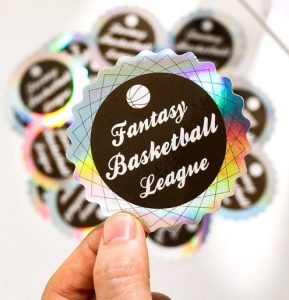
- Promotions and Branding:
Businesses leverage holographic stickers to create eye-catching promotional materials, such as stickers, labels, and decals. The shimmering effects of holography draw attention and leave a lasting impression on consumers.
- Educational Tools:
Holographic stickers have also found their way into educational settings, where they are used to illustrate complex scientific concepts or to engage students in interactive learning experiences.
- Consumer Appeal:
The allure of holographic stickers extends to consumer products like fashion accessories, tech gadgets, and stationery. The dynamic visual effects of holography enhance the appeal of these products and attract consumers seeking a touch of futuristic elegance.
Ethical and Environmental Considerations
While holographic stickers offer a captivating visual experience, it is essential to address potential concerns regarding their environmental impact. Many holographic stickers are produced using materials that may not be easily recyclable, leading to potential waste issues. As the demand for sustainable solutions continues to rise, innovators in the field are exploring eco-friendly alternatives and biodegradable materials for holographic applications.
The Future of Holographic Stickers
As technology continues to evolve, holographic stickers are poised to undergo further transformation. Advancements in materials science, nanotechnology, and optics may lead to even more intricate and realistic holographic displays. Moreover, the integration of augmented reality (AR) and virtual reality (VR) technologies could open up new dimensions of interactivity, allowing users to engage with holographic stickers in immersive and unprecedented ways.
Holographic stickers have transcended their scientific origins to become a fascinating fusion of art, science, and commerce. These alluring illusions have secured their place in various industries, captivating our senses and enriching our visual landscape. As we continue to explore their potential, holographic stickers are sure to keep us spellbound with their enchanting play of light and color, reminding us of the ever-innovative capabilities of human creativity and technological prowess.